
Blog
You Might Be Right
On August 4, The Free Press posted a video with this caption:
“Ever feel like you’re being watched? You might be right. But Flock Safety cameras aren’t interested in you, unless you’re a kidnapper, a thief, or up to no good. @SulkinMaya dives into why people need to stop destroying tech that’s actually stopping crime.”
Three claims are doing work in those two sentences: that the cameras are not interested in the innocent, that objecting to them puts you in the company of kidnappers and thieves, and that the correct response to a nationwide license-plate-tracking network is to stop interfering with it. Take them one at a time, and then look at who is telling you this.
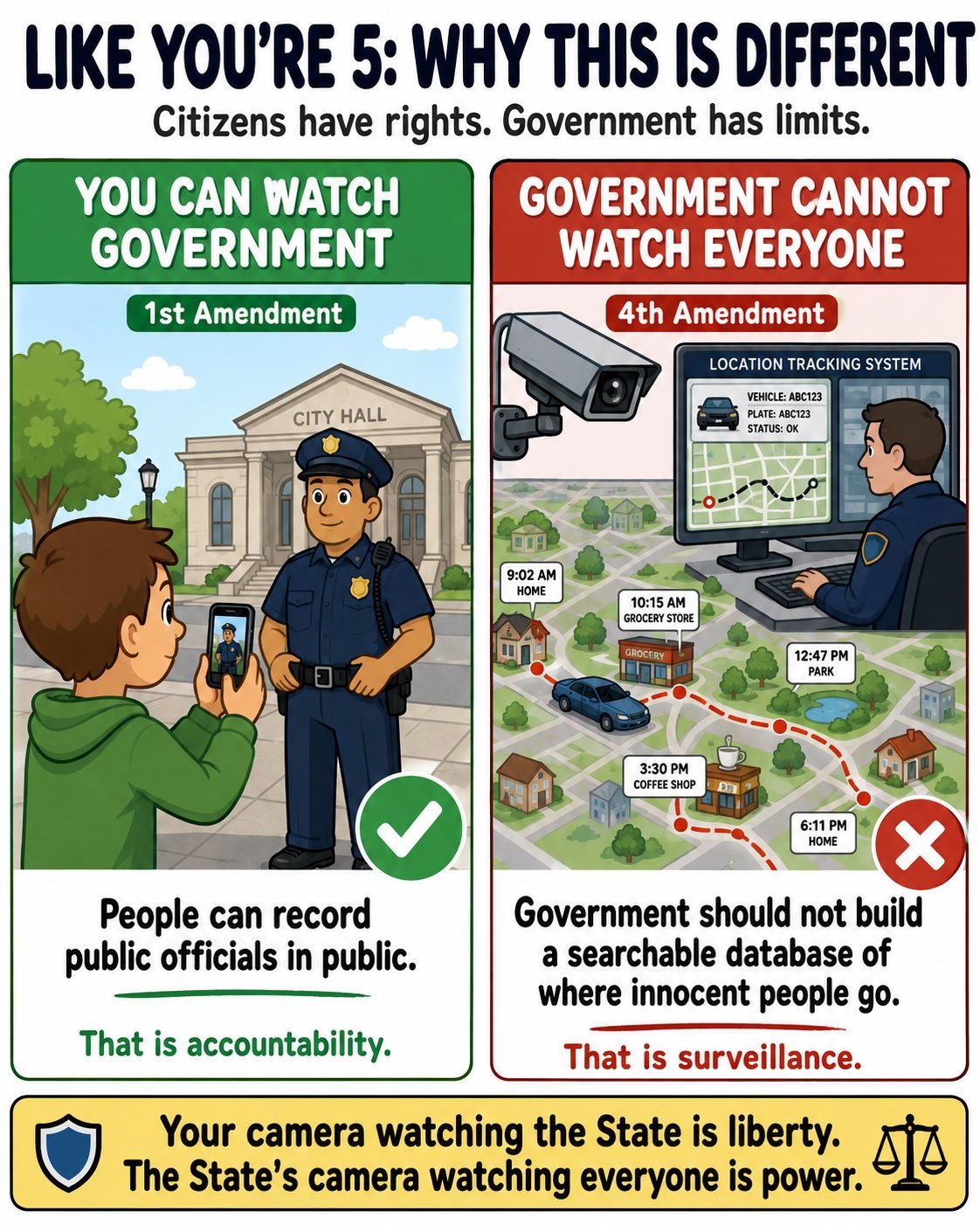
“Not interested in you” is not how the camera works
A Flock camera cannot know in advance which car belongs to a kidnapper and which belongs to someone driving to church. It photographs every plate that passes, innocent and guilty alike, and checks each one against a list. The only way to catch the rare guilty plate is to first record the common innocent one. That is not a design flaw The Free Press’s line glosses over. It is the entire mechanism. A system that has to watch everyone to eventually flag someone is not “not interested” in the everyone. The everyone is the raw material.
We have been over this exact bargain before. The British officers who searched colonial homes on a general warrant also caught real smugglers. That is precisely why the power was tempting, and precisely why the country that abolished it decided a tool that finds the guilty by watching everyone is not justified by the guilty it finds. It is condemned by the everyone it watches. “You have nothing to worry about unless you’re up to no good” was the general warrant’s pitch too. We settled that argument in 1776.
Destroying tech, or refusing a system that offered no other exit
The video’s second move, that people need to “stop destroying tech that’s actually stopping crime,” treats camera vandalism as pure vandalism, with no cause worth naming. Look at what residents in camera towns have actually been offered as a lawful alternative before reaching for an angle grinder.
Mountain View, California restricted its camera network to in-state searches. More than 250 outside agencies queried it anyway, nearly 600,000 searches the city never approved, and residents found out by accident. Cleveland’s city council voted to end its Flock contract; Flock kept the cameras running and police kept using them until the council reversed itself. Evanston terminated its contract, Flock took the cameras down, then reinstalled them without permission and did not finish removing them for months. Dayton and Evanston both ended up with city workers pulling trash bags over live cameras, because the contracts they had signed gave them no faster way to make a camera stop recording. That is the menu a resident who wants a camera off their street has actually been handed: file a complaint, wait for a council vote, watch the company keep filming anyway, or get a trash bag.
None of that excuses destroying anyone’s property. But a video that asks people to “stop” without asking why they started is not making an argument. It is skipping the one question that would complicate the caption: what happens to a citizen’s normal channels for withdrawing consent when the vendor keeps operating regardless of what the contract or the council says. Denver managed a clean, full removal of its 110 cameras when its contract lapsed. That it took a rare, well-lawyered exception to get an ordinary outcome tells you how far outside the norm “the system simply stops when you tell it to” actually is.
Who is telling you this
Here is the part the caption did not include. Marc Andreessen personally angel-invested in The Free Press’s 2022 seed round, alongside David Sacks. Andreessen also co-founded and leads Andreessen Horowitz, the venture firm that led Flock Safety’s $150 million Series D and, in 2025, a $275 million round that valued the company at $7.5 billion. a16z’s own announcement of both deals is public on its website. The same investor backing the outlet is the head of the firm that has poured hundreds of millions of dollars into the company that outlet is now defending on video.
To be precise about the current picture: Paramount Skydance bought The Free Press outright in October 2025 for a reported $150 million, so the outlet posting this video is today a subsidiary of one of the largest media conglomerates in the country, not the scrappy independent operation its brand still trades on. What is not publicly documented is whether Andreessen retained any equity or influence in that new structure. What is documented, plainly, is that the same man financially backed the outlet at its founding and leads the firm bankrolling the product the outlet is telling its audience to stop resisting. A relationship like that gets a disclosure line under the video, not left for a crowdsourced community note to surface after a million and a half people had already watched it.
The nothing-to-hide line runs both ways
“Ever feel like you’re being watched? You might be right.” The Free Press meant that as a hook, then spent the rest of the caption talking you out of worrying about it. Take the hook seriously instead. You should feel a little watched, not by the camera on the pole, but by the fact that the outlet urging you to trust it shares an investor with the company selling the cameras. If the standard on offer is that only people with something to hide object to being watched, it is worth asking what an undisclosed financial relationship between a news outlet and its subject was supposed to be hiding.
Sources
- The Free Press on X, August 4, 2026
- Andreessen Horowitz: Investing in Flock Safety
- Flock Safety: Flock Safety Raises $150M Series D Led by Andreessen Horowitz
- Bloomberg: Andreessen Horowitz Leads Funding Valuing Flock Safety at $7.5 Billion
- Sacra: The Free Press revenue, valuation and funding
- CNBC: Paramount Skydance to acquire Bari Weiss-founded Free Press
- Axios: Paramount Skydance acquires The Free Press for $150M
- This site’s own Sold as Local Control, for the Mountain View, Cleveland, Evanston, Dayton, and Denver facts on what happens when a city tries to withdraw consent from a Flock contract